

Unlocking More Power From America’s Existing Gas Turbines
How Mantel’s carbon capture system can increase the output and efficiency of generation assets already connected to the grid
How Mantel’s carbon capture system can increase the output and efficiency of generation assets already connected to the grid
The future of power depends on answering a fundamental question: how can we bring more reliable capacity online fast enough to meet rapidly growing demand? Part of the answer is already connected to the grid.
After nearly two decades of relatively flat electricity demand, U.S. power demand is now growing as AI, data centers, and manufacturing expand. U.S. power consumption hit a record high of 4,195 billion kWh in 2025 and is projected to continue increasing. Meeting that demand will require more reliable, dispatchable power generation brought online fast.
Today, increasing power supply means clearing two major hurdles. First, the generation has to be built, and then it has to be connected to the grid. Mantel offers another pathway. By pairing existing and connected simple-cycle gas turbines with Mantel’s carbon capture and heat-recovery system, underutilized peaker plants could run more often and increase their capacity by up to 90%. The same turbines generate more electricity with greater efficiency and lower emissions.
Challenge 1: New generation is constrained by supply chain bottlenecks
Building new generation takes time, and equipment availability is one of the biggest constraints. GE Vernova has reported a gas turbine backlog exceeding 116 GW, while Siemens Energy has reported a 69 GW backlog and Mitsubishi Heavy Industries a 35 GW backlog, that’s a total of 220 GW from the just three manufactures. For utilities and developers, that can mean waiting years for new turbine capacity.
Challenge 2: Connecting new generation takes time, too
Before any new generation can begin delivering power, it must first connect to the grid. According to Lawrence Berkeley National Laboratory, roughly 8,200 gas turbine projects representing more than 2,000 GW of proposed capacity were waiting in U.S. interconnection queues at the end of 2025, with median wait times exceeding five years.
Electricity demand is rising faster than new generation can be connected, but existing peaker plants don’t have either of these problems. Their gas turbines are already installed, operating, and contributing to the grid.
One of America’s largest power resources spends most of its life waiting
Natural gas peaker plants were built to respond quickly when electricity demand spikes. These plants typically only turn on as a safety net during heat waves, winter storms, and other moments of grid stress.
Now, the way the grid operators manage those peaks is evolving. Grid-scale batteries are increasingly able to provide rapid, short-duration support. Virtual power plants and smarter demand-response tools, including flexible industrial loads and managed EV charging, can also help shift or reduce demand during periods of grid stress.
As these tools take on more of the short, infrequent demand spikes these assets have served, some peaker plants could see their already-low utilization fall further. Peakers run for less than 10% of the year, often for just a few hours at a time. The U.S. Energy Information Administration (EIA) estimates only 20% of peaker capacity operated during peak periods in 2022.
Unfortunately, unlocking more generation from those assets is not as simple as running them more often. Simple-cycle gas turbines are less efficient than combined-cycle plants because they do not recover the heat leaving the turbine in the exhaust. Running them for significantly more hours would increase both fuel consumption and emissions.
Mantel estimates that bringing an additional 220 GW of existing peaker capacity online without improving its efficiency or capturing its emissions could generate more than one billion tonnes of CO₂ annually, putting the scale of those emissions in the same range as the global aviation industry.
Since peakers can’t simply turn into baseload plants, the opportunity is to make existing gas generation more productive — generating more electricity, more efficiently and with significantly lower emissions, while still leaving grid operators the flexibility to dispatch those assets when and how the system requires.
Mantel’s carbon capture system can do exactly that.
Carbon capture that creates more power
Carbon capture has historically come with an energy penalty. Conventional amine-based capture systems typically operate at low temperatures, where thermal energy passing through the system is wasted, driving costs between $100 to $200 per tonne. For power plants, that wasted energy means consuming more energy to capture CO₂, leaving less electricity available for the grid.
Mantel was designed around the opposite idea: delivering a carbon capture solution that recovers and reuses energy that would otherwise be wasted, making the power plant more productive rather than less.
Mantel’s molten borate carbon capture system operates at high temperatures, allowing it to recover useful heat from both the gas turbine exhaust and the capture process itself. That heat is converted into high-pressure steam, which can then be used to generate additional electricity, all while capturing up to 95% of its CO₂ emissions.
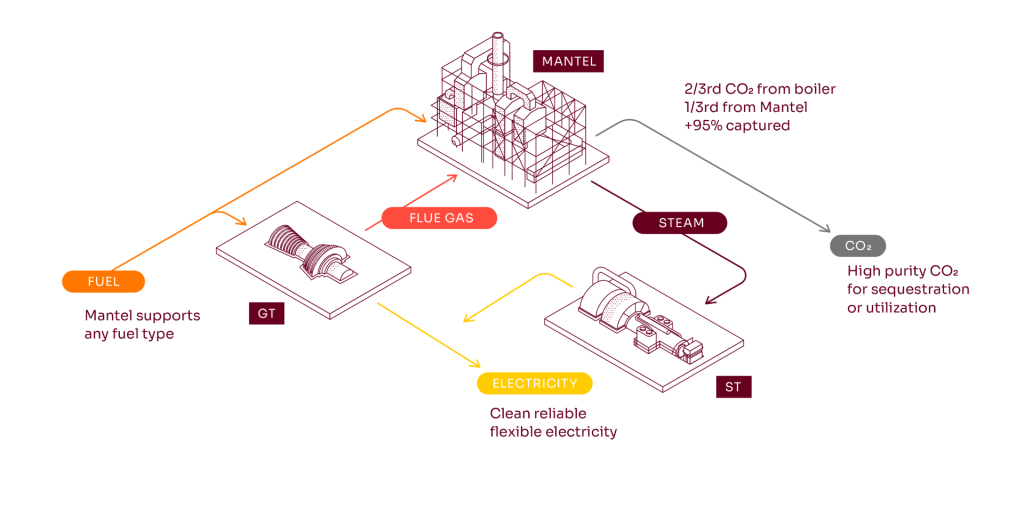
Figure 1: Mantel’s carbon capture system integrates with a gas turbine to recover heat, generate additional steam-cycle power and capture more than 95% of CO₂ emissions for sequestration or utilization.
By adding Mantel’s system, a gas turbine can gain the heat-recovery and steam-cycle benefits of a combined-cycle plant while integrating carbon capture for lower emissions. In representative configurations, Mantel can increase the rated capacity of the plant by nearly double while capturing more than 95% of the CO₂ emissions. The resulting power can reach a carbon intensity below 25 kg CO₂ per MWh, comparable to the lifecycle carbon intensity of renewables.
The economics change, too. Mantel’s modeling shows that for many cases the levelized electricity costs can be lower than conventional combined cycles with prevailing incentives, such as 45Q. And, because the system is designed around standard turbine classes from major manufacturers including GE Vernova, Siemens Energy and Mitsubishi Power, the same architecture can be applied across a broad existing fleet rather than engineered from scratch for every plant. For existing peaker plants, that means getting power from the same installed equipment.
Unlocking more power from infrastructure that already exists
Plant owners and grid operators still decide when the assets run, but when they do, the same turbine can deliver more electricity, operate more efficiently and produce substantially lower CO₂ emissions, providing another way to increase available generation without waiting for new infrastructure or interconnections.
At a time when electricity demand is rising faster than new infrastructure can be built, getting more from the generation already in place may be one of the most effective ways to add useful power to the grid.


